English
  中文简体
中文简体 
Content
- 1 What Aluminum Casting Alloys Are and Why the Answer Matters
- 2 The Most Common Aluminum Alloys Used for Casting
- 3 A Closer Look at Each Common Grade
- 3.1 A356 / 356 — the heat-treatable workhorse
- 3.2 319 — the elevated-temperature grade
- 3.3 535 — the ductile and corrosion-resistant option
- 3.4 A380 — the die casting standard
- 3.5 A383 — the thin-wall specialist
- 3.6 A360 — the dense and corrosion-resistant die alloy
- 3.7 A413 — the maximum-fluidity alloy
- 3.8 B390 — the wear-resistant hypereutectic alloy
- 4 How to Choose the Right Alloy: Seven Criteria That Decide the Grade
- 5 How the Casting Process Limits the Alloy List
- 6 Application-Driven Alloy Selection: Examples from Our Production Floor
- 7 Common Casting Defects That Are Influenced by Alloy Choice
- 8 Working with a Custom Aluminum Die Casting Manufacturer
- 9 Frequently Asked Questions About Aluminum Casting Alloys
If your engineer has just asked you "what aluminum alloy is used for casting?" before you send the RFQ to a supplier, the direct answer is: A356 for sand and permanent mold casting, A380 for high-pressure die casting, and A383 when the casting has very thin walls or complex internal passages. Those three grades cover a large share of the custom aluminum parts we produce for automotive, motor, instrumentation, and fluid-control customers. The alloy choice, however, is never a standalone decision. It interacts with the casting process, the part geometry, the end-use environment, and your cost target.
This guide explains the alloy numbers from the perspective of a manufacturer that operates its own mold shop, die casting cells, machining lines, and surface treatment lines. Instead of repeating textbook definitions, it focuses on the trade-offs that actually affect your part: which alloy fills a thin wall cleanly, which one stays pressure-tight, which one machines well, and which one will survive a salty or humid environment for years. You will also find a comparison table, a property chart, and a set of questions to ask before you commit to a supplier.
What Aluminum Casting Alloys Are and Why the Answer Matters
Casting alloys are not the same as the aluminum grades you see in extrusion profiles or sheet metal. A wrought grade like 6061 is selected because it can be rolled, drawn, or extruded into a shape. A casting alloy must do something harder: it has to fill a mold cavity cleanly, solidify without internal tearing, and still produce a part with known mechanical properties. That is why casting alloys contain a deliberately balanced mix of silicon, copper, magnesium, iron, and other trace elements.
Silicon is the most important element in a casting alloy. It improves fluidity, which means the liquid metal can reach thin sections before it freezes. It also reduces shrinkage porosity because the solidification range narrows as silicon content increases. Most commercial aluminum casting alloys sit between 5% and 12% silicon, with a few special grades going above 16% for wear applications. Copper adds strength and hardness at room temperature and at elevated temperature, but it lowers corrosion resistance and can make the alloy more prone to hot tearing. Magnesium creates the precipitation-hardening effect behind the T6 temper; it is the element that allows A356 to reach its high-strength state. Iron is normally an impurity that forms brittle needles, but in die casting a controlled iron level of about 0.8% to 1.2% is intentionally kept in the alloy to reduce soldering between the casting and the steel die.
If you want a step-by-step explanation of how these alloys move through the mold-making, melting, casting, trimming, machining, and surface treatment stages, read our complete guide to aluminum casting before you start the sourcing conversation.
The Most Common Aluminum Alloys Used for Casting
Across foundries in North America, Europe, and Asia, the same alloy names appear in the majority of purchase orders. The table below lists the grades you will meet most often, with the elements that define them and the applications where they perform best.
| Alloy | Casting Process | Silicon (%) | Copper (%) | Key Strengths | Typical Applications |
|---|---|---|---|---|---|
| A356 / 356 | Sand, permanent mold | 6.5-7.5 | ≤0.20 | Heat-treatable, weldable, ductile, corrosion-resistant | Automotive structural parts, valve bodies, instrument housings |
| 319 | Sand, permanent mold | 5.5-6.5 | 3.0-4.0 | Good strength at elevated temperature | Cylinder heads, intake manifolds, industrial castings |
| 535 | Sand | 0 | 0 | High ductility, resists seawater | Marine hardware, structural brackets, safety components |
| A380 | Die | 7.5-9.5 | 3.0-4.0 | Excellent castability, pressure tightness, good strength | Motor housings, electronics enclosures, brackets, covers |
| A383 | Die | 9.5-11.5 | 2.0-3.0 | Superior filling of thin walls, less shrinkage | Thin-wall housings, telecommunication and computer parts |
| A360 | Die | 9.0-10.0 | ≤0.6 | Dense structure, good corrosion resistance | Hydraulic couplings, valve housings, pump parts |
| A413 | Die, permanent mold | 11.0-13.0 | ≤1.0 | Highest fluidity, very pressure tight | Compressor bodies, complex thin-wall hermetical parts |
| B390 | Die | 16.0-18.0 | 4.0-5.0 | Exceptional wear resistance, low expansion | Cylinder bores, engine blocks, sliding surfaces |
The pattern in the table is simple: as silicon increases, the metal becomes easier to cast and more pressure tight, but harder to machine and less ductile. As copper increases, tensile strength and hardness climb while corrosion resistance drops. This is why the best alloy always depends on the priority of your application.
To compare the three die casting workhorses at a glance, the chart below provides a relative rating for five properties that matter in day-to-day engineering decisions. The scale is a comparative index, not an absolute material value.
A356 property snapshot
A380 property snapshot
A383 property snapshot
A Closer Look at Each Common Grade
The alloy list below is arranged by family so you can compare similar candidates side by side. For each grade, the notes emphasize the real production consequences rather than the datasheet numbers.
A356 / 356 — the heat-treatable workhorse
A356 is the standard choice for sand casting and permanent mold casting when strength, ductility, and weldability are required. It contains about 7% silicon with small amounts of magnesium, which makes it responsive to T6 heat treatment. A T6 temper raises yield strength and hardness considerably while retaining useful elongation. It also has better corrosion resistance than copper-containing alloys, and it can be anodized to a uniform appearance. The main limitation is fluidity: A356 needs a heavier gate system and carefully controlled pouring temperature to fill thin sections. The non-heat-treated counterpart, 356, is specified when the part will be welded or when the cost of heat treatment is not justified.
319 — the elevated-temperature grade
319 adds copper to a leaner silicon level, which raises strength at temperatures of 150°C to 200°C. This makes it a traditional material for cylinder heads, intake manifolds, and engine-related castings. The trade-off is lower ductility and poorer corrosion resistance compared with A356. The alloy also does not have the same fluidity as high-silicon die casting grades, so it is rarely used for complex thin-wall geometry.
535 — the ductile and corrosion-resistant option
535 is a low-alloy grade containing about 4% magnesium and almost no silicon. Its as-cast ductility is among the highest of all aluminum casting alloys, and its corrosion resistance in marine environments is excellent. However, the absence of silicon makes it more difficult to cast: the wide freezing range requires careful feeding with risers, and the melt is prone to oxidation. This grade carries a higher cost and is selected when elongation or seawater performance is critical enough to justify the extra process care.
A380 — the die casting standard
A380 is the most common aluminum die casting alloy worldwide. Its balance of roughly 8% silicon and 3.5% copper gives good fluidity, good strength, and acceptable machinability. Parts such as motor housings, electronic enclosures, and structural brackets are routinely produced in A380 because the alloy fills the die quickly and produces pressure-tight walls with an attractive finish. For most industrial products with no special corrosion demand, A380 is the default specification that keeps the die casting cost in the expected range.
A383 — the thin-wall specialist
A383 holds more silicon and less copper than A380. The higher silicon content lowers shrinkage and improves the filling of thin sections, making it the first choice when a die casting has walls below 2 mm or complex ribs. A383 is also easier to anodize than A380 because of the lower copper. It is widely used in telecommunication housings, computer enclosures, and automotive electronics covers. A useful rule of thumb: if the mold-filling simulation shows flow problems with A380 in a thin-wall part, switch to A383 before changing any geometry.
A360 — the dense and corrosion-resistant die alloy
A360 has around 9.5% silicon and a copper content below 0.6%. The result is a dense, relatively corrosion-resistant die casting alloy with high strength and good pressure tightness. It is often found in hydraulic couplings, valve housings, and pump bodies where leakage must be minimized. The lower copper content gives A360 better resistance to salt spray and mild chemicals than A380, which is why it appears in marine and outdoor equipment.
A413 — the maximum-fluidity alloy
A413 carries 12% silicon and almost no copper. It has the highest fluidity of the standard commercial casting alloys, so it fills extremely intricate cavities and produces pressure-tight parts in complex housings. The low copper also improves corrosion resistance. Compressor bodies, refrigeration fittings, and housings with deep fins are typical A413 applications. Its limits are reduced machinability and lower ductility, which are acceptable when the priority is a leak-free, highly detailed casting.
B390 — the wear-resistant hypereutectic alloy
B390 is a hypereutectic alloy with 16% to 18% silicon and around 4.5% copper. The primary silicon particles give exceptional wear resistance and a low coefficient of thermal expansion, which is why B390 is found in cylinder bores, engine blocks, and sliding components. The same hard silicon particles make machining difficult, and diamond tooling is often required. B390 is selected for performance rather than for economy, and it demands a foundry with experience in hypereutectic alloys.
How to Choose the Right Alloy: Seven Criteria That Decide the Grade
Instead of memorizing alloy datasheets, evaluate your part against the following seven criteria. Each one eliminates certain grades and narrows the list to two or three candidates. The order below follows the way most engineering reviews actually progress.
1. Fluidity and section thickness
If the casting has walls under 2.0 mm, deep fins, or long thin flows, choose a high-silicon alloy such as A383 or A413. For thicker sections above 4 mm, A356 and even A380 remain safe.
2. Pressure tightness
If the part will hold gas or hydraulic fluid, look at A360, A413, or A380. The tight dendritic structure of these alloys minimizes micro-porosity. A356 in sand casting also performs well after T6 heat treatment.
3. In-service corrosion environment
Marine, coastal, or chemical exposure pushes the choice toward A356, A535, or A360. Copper-containing alloys such as A380 and 319 require a protective coating if the part will face salt spray for long periods.
4. Heat treatment and weldability
If the design requires a T6 temper, the alloy must be A356, A357, or a similar heat-treatable grade. If the casting is welded during assembly, A356 is again the safer choice; die casting alloys are difficult to weld without porosity.
5. Machining cost
High-silicon grades such as B390 and A413 wear cutting tools faster, increasing the cost of every machined surface. If the part has many drilled holes or tapped threads, A356 and A360 are friendlier to standard tooling.
6. Surface finish and anodizing
For decorative parts with a visible surface, avoid high-copper alloys. A383 and A356 produce more uniform anodized finishes, while A380 can show color variation in a clear anodize because of copper segregation.
7. Cost and supply stability
A380 is the most available die casting alloy in the market, which keeps its price competitive. Special grades such as B390 or 535 are produced in smaller volumes and can carry longer lead times and higher premiums.
In practice, most components survive a two-step filter: first remove alloys that cannot fill the geometry, then remove alloys that fail the corrosion or heat treatment requirement. The remaining candidate is usually the most economical choice.
How the Casting Process Limits the Alloy List
The process you choose will eliminate more alloys than any other factor. A very complex part with internal passages is often die cast; a large structural component is sand cast; a series of 500 parts might be produced on a permanent mold machine. Each process has its own alloy preferences because the cooling rate and the feeding behavior are completely different.
| Casting Process | Typical Alloys | Why This Combination Works |
|---|---|---|
| High-pressure die casting | A380, A383, A360, A413, B390 | These alloys flow fast, fill thin walls, and resist die soldering |
| Sand casting | A356, 356, 319, 535 | Alloys with good feeding behavior and heat treatment response |
| Permanent mold / gravity casting | A356, A413, 319 | Better strength and finish than sand, still castable in metal molds |
| Investment casting | A356, A357, 319 | Heat-treatable grades match the fine surface and tight tolerance |
High-pressure die casting relies on alloys with narrow solidification ranges, because the metal is injected into the die and must freeze quickly. A380 and A383 were developed for exactly this condition. Sand casting, in contrast, gives the metal time to feed; alloys with a wide freezing range such as 535 can be handled with carefully placed risers. If you try to substitute a die casting alloy into a sand casting pattern, you may lose ductility and corrosion resistance without gaining any cost benefit.
The volume forecast also matters. Die casting has a high initial tooling cost but the lowest unit cost at high volumes. Permanent mold and sand casting tooling is cheaper, but the cycle time is longer and the unit price is higher. The alloy choice follows that economic logic: a die casting grade such as A380 becomes attractive only when the tooling investment can be divided across enough parts.
Application-Driven Alloy Selection: Examples from Our Production Floor
The examples below mirror parts we have produced in our own plant. They show the reasoning steps that a die casting engineer goes through when converting a design into a manufacturable part. Use them as a reference when you brief your next supplier.
Automotive and in-vehicle electronics
Automotive components face vibration, wide temperature swings, and in some cases direct exposure to road salt. For structural or safety-related castings, we typically specify A356 with T6 heat treatment; it gives predictable yield strength, good elongation for crash energy absorption, and corrosion resistance that survives an unpainted underbody environment. For electronics enclosures such as wireless charging housings, A383 is preferred because the thin ribs and snap-fit features fill cleanly and the part can be anodized for a consistent look.
Motor housings
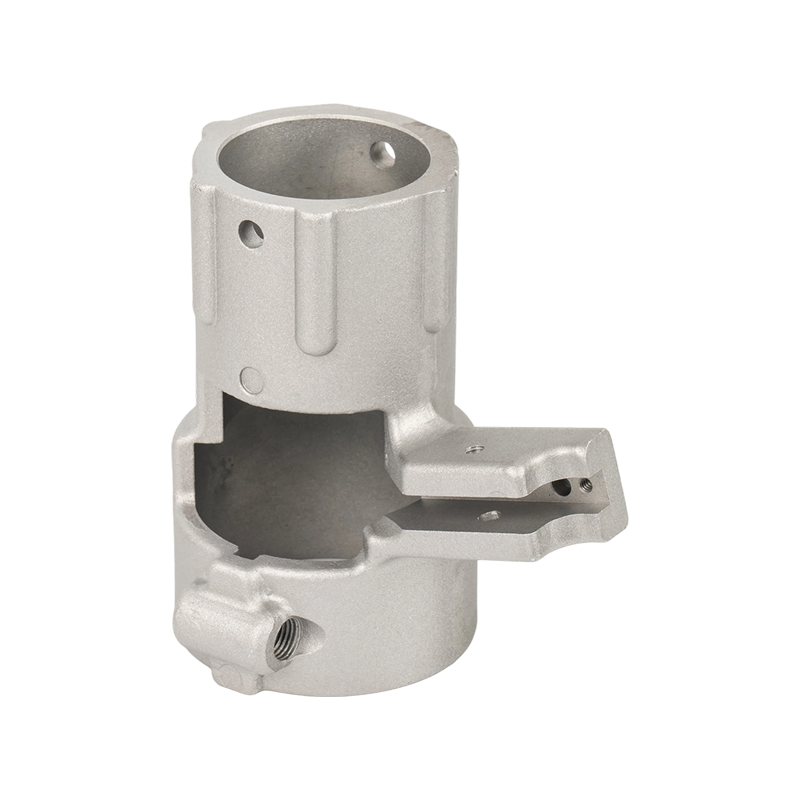
Motor housings need a combination of dimensional stability, thermal conductivity, and sealing at the joint faces. A380 is the standard grade because it casts quickly, holds tight flatness tolerances, and provides a stable bore for the stator. When the motor is exposed to water spray or high humidity, we move to A360 or add a waterproof coating; when the stator fits into a thin-walled can, A383 fills the wall more reliably. The product below is an example of a die-cast motor housing produced with these requirements in mind.
High-Performance Waterproof Motor Housing A die-cast aluminum motor housing designed to maintain structural integrity in wash-down, high-humidity, and continuous-operation environments. View product detailInstrument and control housings
Instrument housings protect sensitive electronics and often carry mounting bosses, viewing windows, and cable glands. The priority here is dimensional accuracy and surface quality. A356 in permanent mold gives the best combination of finish and strength for medium volumes, while A380 or A383 in die casting is chosen when the housing volume exceeds 10,000 pieces per year. For outdoor instrument enclosures, the alloy is selected together with the surface treatment; powder coating covers most alloy differences, but clear anodizing still favors A356 or low-copper die casting grades.
Pressure-reducing valves and hydraulic bodies
Valve bodies must hold pressure, seal against gaskets, and resist internal corrosion from the media. Die-cast A360 and A413 produce the densest structure for hydraulic applications. When the valve body is sand cast or permanent mold cast, A356 in the T6 temper offers verified pressure tightness together with ductility that allows the body to withstand tightening loads at the ports. Every valve part we ship receives a pressure test; the alloy choice is one of the first things we check if a casting ever fails the test.
Die-Cast Aluminum Pressure-Reducing Valve Housing A pressure-tight valve housing produced in die-cast aluminum for gas distribution and fluid control systems that demand leak-free performance. View product detailGeneral equipment and non-standard components
Equipment parts such as brackets, covers, connectors, and fixings rarely face extreme thermal or corrosive conditions. A380 is the default grade because it balances cost, strength, and castability. If the part has a complex shape with multiple undercuts, we review the option of A383 before changing the tool design. For parts that are welded into a larger assembly, we step down to A356 so the weld region remains sound and the final structure does not crack under vibration.
Common Casting Defects That Are Influenced by Alloy Choice
When a defect appears during development, the alloy choice is often the root cause. Understanding the link between the defect and the chemistry of the melt helps you read a supplier's corrective action report with better judgment.
- Shrinkage porosity: Alloys with low silicon such as 319 and 535 have a wide freezing range. They need additional risers and feeders. If the supplier reports internal shrinkage in a thin-wall section, the correct response may be a switch to A383 or a revision of the feeding system.
- Hot tearing: This crack-like discontinuity happens when the solidifying metal is too weak to withstand contraction stress. A356 is less prone to hot tearing than high-copper grades; when a die casting shows hot cracks near inserts, check whether the copper content is at the high end of the A380 range.
- Die soldering: When liquid aluminum welds itself to the steel die surface, the part sticks and the surface tears. A controlled iron content between 0.8% and 1.2% is the standard defense. If soldering recurs, the supplier should verify the iron level in the melt rather than simply changing the die coating.
- Gas porosity: Hydrogen is the main source of gas pores. The alloy itself does not create hydrogen, but high-silicon melts absorb gas when the furnace atmosphere is wet. A vacuum degassing step and dry handling of returned scrap will eliminate most of this defect.
- Tool wear and poor machinability: High-silicon grades such as B390 and A413 wear standard carbide tools quickly. If your unit cost is dominated by machining, compare the total cost of a high-fluidity alloy plus expensive tooling against a slightly thicker wall in A356 that allows lower-cost cutting.
Working with a Custom Aluminum Die Casting Manufacturer
Once you have narrowed the alloy to one or two candidates, the conversation with a supplier should focus on capability and verification. A serious manufacturer will be able to explain the alloy recommendation in writing, provide a composition certificate, and show you the process steps that ensure the casting matches the approved sample.
When requesting a quotation, include the following information: a 3D model in STEP or IGES format, a 2D drawing with GD&T symbols, the material standard you expect the supplier to follow, the annual volume and tooling budget, the surface finish requirement, the pressure or vacuum tightness requirement, the exposure temperature range, and any industry certification that your customer requires. The more complete the inquiry, the more accurate the alloy recommendation will be.
You should also ask direct verification questions: Which alloy and temper is quoted? Which standard covers it? Will the supplier perform a chemical analysis of the first production batch? Can they deliver a material certificate with each shipment? Do they keep the composition window inside the alloy specification or at the edge of it? These questions separate manufacturers that rely on a documented quality system from those that merely pour aluminum.
At our plant, the internal supply chain covers the full sequence: mold workshop, die casting workshop, polishing workshop, machining workshop, cleaning workshop, and warehouse. That one-stop arrangement means the alloy selection is reviewed by the same team that later machines the part, so we catch machinability or corrosion problems before the parts reach your line. We are certified to ISO 9001:2015 and IATF 16949:2016, and our quality records are available for every batch. You can also walk through the workshops remotely and evaluate the equipment and process control before you place an order.
For parts that have demanding tolerance and finish requirements, precision cast components are a typical starting point in our product range.
Precision Aluminum Alloy Cast Parts Custom aluminum castings machined to tight tolerances and ready for surface treatment, for industrial and automotive applications. View product detailIf you would like to see the actual equipment, take a virtual tour of our workshops before the RFQ discussion. The visual evidence of a clean melt area and a well-maintained machine park is worth more than any brochure claim.
Frequently Asked Questions About Aluminum Casting Alloys
Which aluminum alloy is most commonly used for casting?
For die casting, A380 is the most widely specified aluminum alloy in the world. For sand casting and permanent mold casting, A356 is the most common because it combines castability with heat treatment response. Together, A356 and A380 account for the majority of commercial aluminum castings across all processes.
What is the difference between A356 and A380?
A356 is a 7% silicon, low-copper alloy used in sand and permanent mold casting. It responds to T6 heat treatment, welds well, and resists corrosion. A380 is an 8% silicon, 3.5% copper die casting alloy that flows quickly and produces pressure-tight walls, but has lower ductility and weaker corrosion resistance. Choose A356 when strength and corrosion matter; choose A380 when filling a die rapidly and economically is the priority.
Can I use 6061 aluminum for casting?
No. 6061 is a wrought alloy designed for extrusion, forging, and rolling. Its solidification behavior is not suited to filling a mold cavity, and castings produced from 6061 scrap tend to crack and show severe shrinkage porosity. If a supplier offers to cast 6061, treat it as a warning sign and demand a proper casting grade such as A356 or A380.
Which alloy is best for pressure-tight valve housings?
For die casting, A360 and A413 give the densest structures for hydraulic and pneumatic components. A380 is acceptable when copper content does not create a corrosion problem. For sand-cast or permanent-mold-cast valve bodies, A356 in the T6 temper offers a strong combination of pressure tightness, ductility, and corrosion resistance.
Do I need heat treatment on aluminum castings?
Only heat-treatable grades such as A356 respond to T6 processing. Die casting alloys are normally supplied as-cast because their rapid cooling microstructure does not respond well to the same solution treatment, and the added cost is rarely justified. If the application demands higher yield strength and predictable elongation, specify A356 with T6 and design the process around sand or permanent mold casting.
How can I verify that the manufacturer uses the agreed alloy?
Request a material certificate from an accredited testing laboratory with the first article. The certificate lists the actual chemical composition of the melt. You can also ask for a spectrometric analysis report for each production batch, or send a sample from your own stock to an independent laboratory for verification. A manufacturer with a reliable quality system will provide these documents without hesitation.
After reviewing the alloy families, the selection criteria, and the production realities, you may still ask the same question: what aluminum alloy is used for casting? The honest answer is that it depends on your process, your geometry, and the environment the part will live in. But the decision process is now manageable. Start with the process, apply the seven criteria, and ask the supplier to justify the recommendation in writing with a composition certificate.
A foundry that can explain the why behind its alloy choice is usually the foundry that will deliver a consistent casting. The alloy is not a footnote in the quotation; it is the foundation of the dimensional stability, mechanical performance, and durability of every part you receive.
If you are preparing an inquiry and want a practical review of the grade and temper for your application, send us the drawing and the operating conditions. Our engineering team will give you an alloy recommendation with the reasoning included, and the supporting quality records to back it up.